
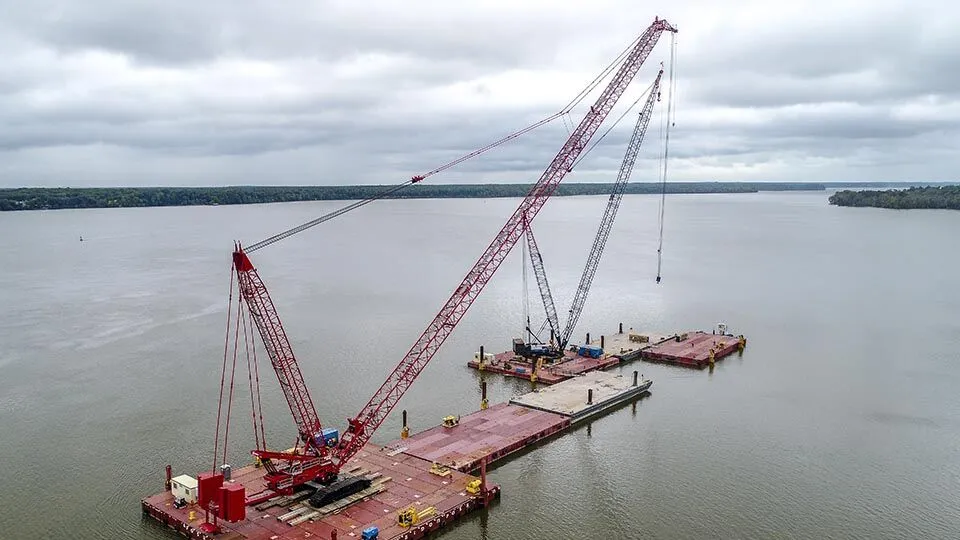
What’s the Secret to Heavy Lifts at Sea? Crawler Cranes on Barges.
Crane barges are indispensable equipment in the marine industry. They are crucial for the installation and removal of offshore oil and gas platforms, the installation of large turbine foundations for wind farms, and the construction of bridges, docks, and seawalls. Read this article to learn about the characteristics, advantages, and considerations of barge and crane.
What is a crane barge?
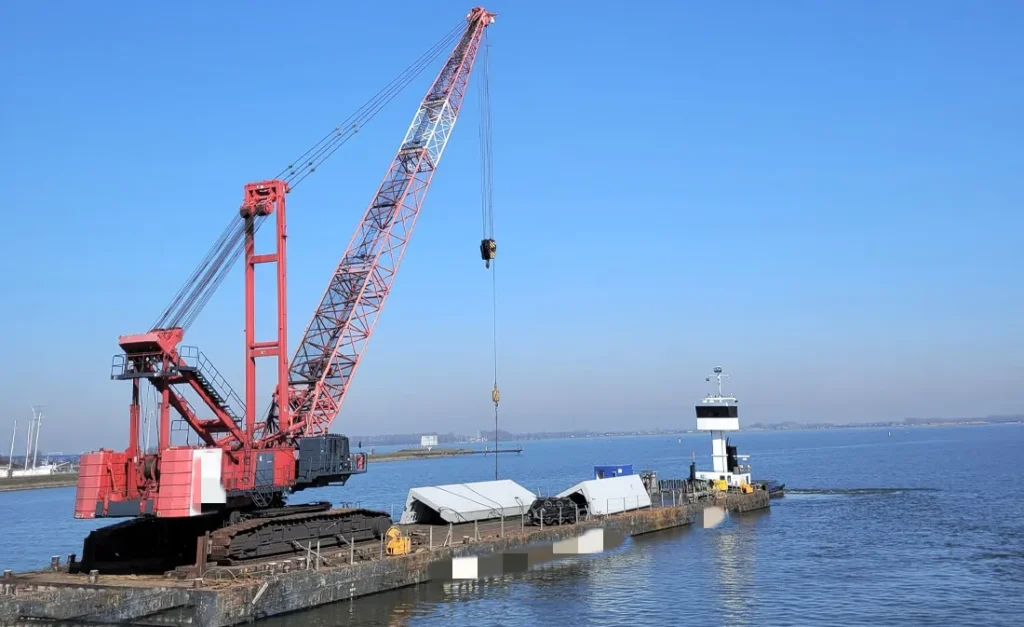
A crane barge is a specially designed offshore heavy-lift platform whose core function is to provide a stable and mobile operational base for large cranes in nearshore or offshore environments where traditional land-based equipment cannot reach. It is essentially an engineering vessel that combines lifting capacity with waterborne transportation capabilities.
Core Features and Advantages
Exceptional Mobility and Cost-Effectiveness
Highly Mobile and Flexible: These vessels can tow or self-propel to any navigable waters, such as ports, nearshore areas, or offshore wind farms. They turn the water surface directly into a working platform, eliminating the need for costly temporary roads, docks, or land reinforcement.
Rapid Deployment and High Cost-Effectiveness: Integrating transportation and lifting functions, it achieves “one-stop” operation for material transportation and on-site installation, significantly shortening project cycles and reducing overall costs.
Designed for Stability
Optimized Hull Structure: Typically features a box-shaped, flat-bottomed hull and a wide deck to achieve a low center of gravity and a large waterline area, prioritizing stability over speed.
Advanced Stability System: Equipped with a sophisticated ballast water system that dynamically adjusts the vessel’s trim and draft to counteract overturning moments and wave effects during lifting operations. Advanced vessels also feature dynamic positioning systems that automatically maintain precise vessel position, ensuring precise operations in deep water.
Powerful Lifting and Operational Capabilities
Extreme Load Capacity: As a dedicated platform, it can carry heavy-duty cranes with lifting capacities ranging from hundreds to thousands of tons, meeting the ultra-heavy load requirements of offshore installation.
Spacious Working Area: The open and robust deck not only provides a base for the crane but also serves as a comprehensive logistics center, allowing for the centralized storage of all construction materials and equipment, such as piles and modules, placing all resources within the crane’s working radius and significantly improving operational efficiency.
Built-in High Security
Multiple Safety Redundancies: The design includes redundant ballast and power systems to ensure continuous operation.
Comprehensive Monitoring and Protection: Integrates advanced crane load monitoring, anti-collision systems, and a full suite of maritime navigation and safety equipment. The structural design is capable of withstanding harsh sea conditions, ensuring the safety of personnel and assets.
Types of Crane Barges
From a design perspective, crane barges can be categorized into the following primary types and configurations:
1. Flat-Deck Crane Barges
These are simple, flat-hulled barges equipped with one or more standard lifting cranes. The cranes may be either fixed or capable of rotation. Larger versions of this type can handle substantial loads, typically ranging from 1,000 to 2,000 tonnes, and sometimes more. They serve as versatile, cost-effective solutions for various inshore and nearshore lifting tasks.
2. Derrick Barges
Derrick barges are specialized vessels with a fully rotating crane system, known for their high lifting capacity. They mainly serve offshore construction, installation, and repair projects. Lifting capability varies widely:
- Smaller units handle 50 to 500 tonnes.
- Larger modern derrick barges often lift over 1,000 to 1,500 tonnes with a single crane.
- Some advanced setups use two or more cranes to lift over 10,000 tonnes combined.
For stability, crews position the derrick forward—about 20–25% of the vessel’s length from the stern. The barge’s width helps distribute structural load evenly during lifts. A key challenge is listing (tipping), which operators control using ballast or counterweights, along with two or three swing engines during lifts, depending on crane size.
3. Sheerleg Crane Barges
This type uses a non-rotating heavy-lift crane built from an A-frame structure made of tubular or truss members. Sheerlegs can handle a wide range of loads—from as little as 50 tonnes up to 10,000 tonnes. Smaller sheerleg barges typically lack propulsion and need towing, while larger models are usually self-propelled, with engines on deck or as outboard units. During a lift, the crew carefully positions the barge, and the A-frame adjusts to keep balance once the load is engaged. The deck machinery must be strong enough to resist motion from the sea in all six degrees of freedom.
4. Heavy-Lift Catamaran Crane Barges
These highly specialized vessels tackle the most demanding offshore construction and installation projects, handling extreme loads. Their twin-hull (catamaran) design provides a stable base. A giant, fixed crane forms an arch-like structure between the hulls, mounted symmetrically to lift massive loads directly from the central space. This configuration delivers exceptional stability. The massive vessels either move under their own heavy-duty propulsion or rely on multiple tugboats to reach their worksites.
Crane Barge Applications
Offshore Energy Development:
Primarily used for the installation of offshore wind farms (foundations, towers, and turbines), as well as the construction, module installation, and decommissioning of oil and gas platforms. It is a crucial piece of equipment for constructing deep-sea energy infrastructure.
Port and Bridge Construction:
A key piece of equipment for the construction and maintenance of docks, breakwaters, and locks, used for lifting large caissons, piles, and bridge decks. In cross-sea bridge projects, it is responsible for installing prefabricated bridge sections in the water.
Maritime Engineering and Lifting Operations:
Specializes in the transportation and installation of heavy equipment, submarine pipeline laying, launching or dry-docking of large vessels, and completing various complex offshore salvage and rescue missions.
Coastal Protection and Land Reclamation:
In coastal engineering projects, it is used for the precise placement of giant concrete tetrapods, revetment stones, and other protective structures. It is also a standard solution for installing critical hydraulic components in large-scale dredging and land reclamation projects.
Critical Considerations for Barge-Mounted Crawler Cranes
I. Core Stability and Load Analysis
This is the primary prerequisite for all considerations.
Ship Stability Calculation: A complete stability calculation must be performed by a professional naval architect. The focus is on analyzing whether the entire system has sufficient righting moment when the crane is at its maximum working radius, lifting the maximum load, and the barge is at the maximum allowable heel and trim angles (usually 2-3 degrees).
Crane Load Distribution: Accurately calculate the local pressure exerted on the barge deck by the crane’s outrigger forces during no-load, full-load, and slewing operations. This determines whether local deck reinforcement is required.
Center of Gravity and Buoyancy Matching: Determine the optimal position for installing the crane on the barge to optimize the center of gravity of the entire floating unit, ensuring it matches the center of buoyancy and maintains good initial stability.
II. Crane and Barge Compatibility
Crane Selection:
Choose crawler crane models with a compact chassis and a low center of gravity. Even after accounting for barge tilt, the crane must still deliver the required working radius, lifting height, and lifting capacity for the project.
Deck Strength and Reinforcement:
Standard barge decks cannot handle the concentrated loads from crawler cranes. After performing a load analysis, weld high-strength pads or support trusses beneath the crane tracks to spread the load evenly to the hull’s main structural members.
Connection and Fixing System:
Never simply set the crane on the deck. Use high-strength shear connectors—such as stoppers, welded bases, or special clamps—to secure the crane chassis rigidly to the deck. This prevents sliding and tipping from wind and wave forces, and is essential to avoid crane drift or overturn at sea.
III. Environmental and Operational Safety
Marine Environment Adaptability:
Ensure the crane receives corrosion-resistant treatment and the electrical system achieves a higher protection rating. All operators must complete offshore operations safety training.
Dynamic Motion Effects:
The work plan must account for the barge’s heave, roll, and pitch motions, as these affect precise hook positioning and can amplify load forces. Therefore, establish clear, safe working limits for sea conditions.
Integrated Monitoring System:
Install an integrated system to monitor key parameters in real time, such as barge tilt, crane structural stress, load weight, and wind speed. Link this system to the crane’s safety controls to provide alerts and enable automatic protective actions.
IV. Auxiliary Systems and Logistics
Power Supply: Determine whether the crane will be powered by the barge’s power plant or requires an independent diesel generator set, and ensure a stable and compatible power supply.
Mooring and Positioning: Design a reliable anchoring system based on the tides, currents, and wind conditions of the operating area. For operations requiring high precision (such as wind turbine installation), consider using a dynamic positioning system.
Personnel Access and Safety Facilities: Provide safe access for crew members to board and disembark the vessel, and install guardrails and safety nets along the edges of the crane and barge to prevent personnel from falling into the water.
Crane Models Suitable for Barge Mounting
| Model Series | Core Advantages | Typical Application Scenarios |
| Liebherr LR Series | The modular design allows for flexible configuration of counterweights and lifting arms based on barge size and project requirements. The compact tail swing radius minimizes the space occupied on the barge deck. The advanced V-shaped undercarriage structure provides superior stability. | Models like the LR 1130, LR 1160, and LR 1600/2 are commonly used for offshore wind farm projects, port construction, and heavy equipment lifting. |
| Manitowoc MLC Series | The Variable Position Counterweight (VPC) technology is the core advantage. During lifting, the counterweight can move rearward to increase stability; during transport, it retracts to reduce size and weight, perfectly adapting to the space constraints and load distribution requirements of a barge deck. | Models such as the MLC100, MLC300, and MLC650 are particularly suitable for heavy lifts on barges with limited space. |
| Demag (Terex) CC Series | Known for its powerful lifting capacity and exceptional working radius. Their heavy-duty undercarriage and robust structural design enable them to handle complex dynamic loads on a barge. | Models like the CC 2800-1, CC 8800-1 are suitable for ultra-heavy offshore structure installation. |
| Sany SCC Series | Offers excellent performance-to-price ratio and good adaptability. Newer models are designed with marine conditions in mind, featuring corrosion protection systems and enhanced structures. | Models such as the SCC1500 and SCC4000A are widely used in various nearshore engineering and infrastructure construction projects. |
In summary, as a crucial force in offshore engineering, crane barges, with their unparalleled flexibility and powerful lifting capacity, have become a bridge connecting land-based operations with deep-sea projects. From energy development to infrastructure construction, their applications are continuously expanding the boundaries of engineering. In the future, with the continuous advancement of technology, crane barges will continue to play an irreplaceable core role in the global maritime engineering field, supporting humanity’s efforts to explore and build in the deeper reaches of the ocean.