What Are the Three Main Types of Crane Pulleys?
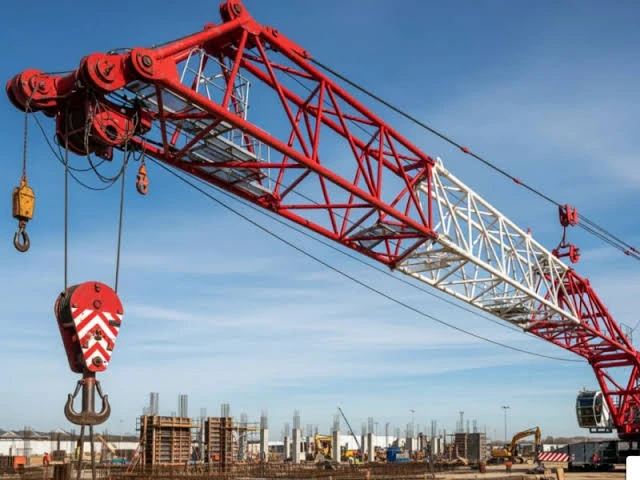
A crawler crane is a heavy lifting machinery which lifts and moves loads within varying conditions. The critical component in this case is the pulley, which is responsible for directing the ropes or cables used to move the load. Knowledge of the various kinds of crane pulleys is important for anybody involved in the construction or repair of crawler crane parts since the wrong combination can affect not only the lifting capacities but also the safety of the whole machine.
The Role of Pulleys in Crawler Cranes
Pulleys are lifting machines elements which serve to alter the direction of a hoisting rope or cable, which is necessary for transferring the lifting force. In crawler cranes, the pulleys are built to withstand very heavy loads and the resulting stress during the lifting process. In fact, pulleys are parts of the crane’s hoisting system, which comprises the hoist drum, ropes, and the block and tackle mechanism forming the pulley block or system.
The role of the pulleys in crawlers cranes is to reduce the amount of effort required to lift very heavy loads.
Types of Crane Pulleys
1. Fixed Pulleys
Fixed pulleys are the workhorses of crawler crane components. They remain stationary and are securely mounted to a fixed bracket on the boom or superstructure. Their primary function is to change the direction of the wire rope without providing a mechanical advantage.
Key Characteristics:
Simple structure and easy maintenance
Change the direction of the lifting rope
Provide mechanical advantage when used in conjunction with a movable pulley system
Generally more affordable than movable pulleys
Best For:
General lifting tasks involving vertical movement
Applications requiring consistent directional control
Environments with minimal repositioning needs
While fixed pulleys do not directly reduce the lifting load, they provide the necessary mechanical advantage when used in combination with movable pulleys.
2. Movable Pulleys
Movable pulleys are able to move along a defined track or track system. This versatility allows them to change the direction of rope or cable pull, enabling complex lifting operations and multi-directional movement of loads. In most crawler crane systems, the movable pulley is part of a pulley block system where the cable is wrapped around multiple pulleys.
Key Characteristics:
Reduces the force required to lift heavy objects
Often used in pulley blocks with multiple crawler crane pulleys
Increases lifting equipment capacity and efficiency
Adapts to changing lifting scenarios and complex configurations
Best For:
Specialized lifting operations that require precise control and maneuverability
Applications requiring multi-directional movement of the load
Situations where changes to the crane configuration are required
By using multiple movable pulleys, the system can lift heavier loads with less force—a significant advantage in heavy lifting operations.
3. Suspension Pulleys and Pulley Block Systems
Suspension pulleys are typically attached to a bridge structure or gantry as the primary point for hanging and supporting heavy objects. They evenly distribute the weight of the load across the supporting structure, ensuring safe and stable lifting operations.
A pulley block is a collection of multiple pulleys (fixed and movable) housed in a single unit. A pulley block is a more complex system than a single pulley that provides greater lifting efficiency. By combining multiple pulleys, a pulley block can increase the mechanical advantage, allowing crawler cranes to lift extremely heavy loads with relatively low force.
Key Characteristics:
Multiple pulleys (fixed and movable) within a single block
Mechanical advantage for lifting heavy objects
Evenly distributes weight, minimizing stress on supporting structures
Commonly used in large construction and lifting tasks
Best For:
Long-term lifting operations involving large, heavy loads
Construction projects requiring lifting and positioning of large components
Continuous lifting applications in industries such as construction and shipbuilding

How to Choose the Right Crane Pulley Configuration
1. Load Tonnage and Lift Capacity
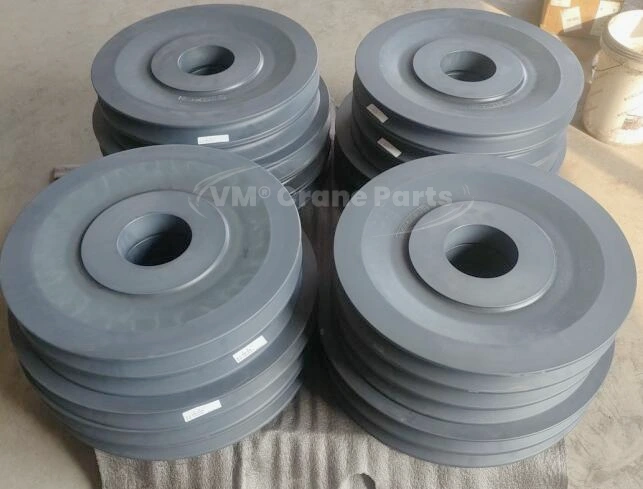
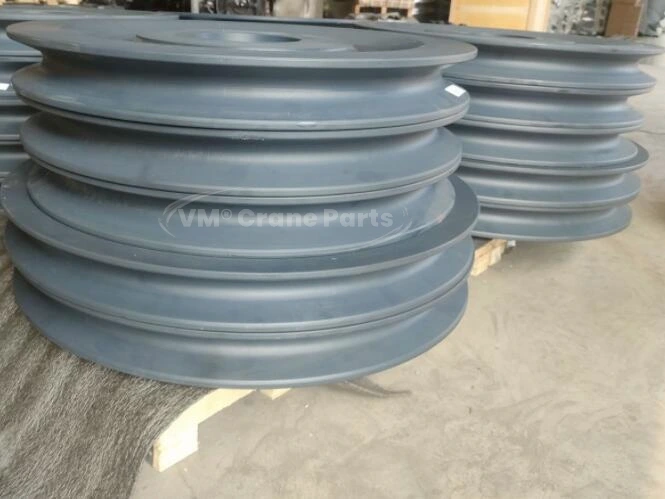
The pulley should have an adequate lift capacity based on the maximum load to be lifted. Heavy-duty loads necessitate the use of multi-groove pulleys which are made up of strong forged or cast steel to handle extremely high cable tensions.
2. Number of Parts of Line
Depending on the number of parts of line used, simple single-line system may not need multi-groove pulleys while complicated multi-part system requires multi-groove pulleys that have three or more grooves.
3. Size of Pulley and Rope Compatibility
This is very crucial because the ratio of pulley diameter to wire rope diameter (D/d ratio) determines the efficiency of the system. In order to minimize fatigue bending and enhance wire rope life, it is recommended that the D/d ratio of heavy or frequent lift systems should range from 30 to 45. The larger the pulley diameter, the longer the rope life.
4. Groove Angle and Condition
The groove must match the wire rope diameter and configuration to provide adequate support. An angle of about 35° to 45° is recommended for the groove of the pulley.
Frequently Asked Questions About Crawler Crane Pulleys
Q: How are fixed pulleys and movable pulleys different in a crane pulley system?
A fixed pulley is fixed on a solid mounting frame and works as an effort multiplier but does not provide a mechanical advantage. A movable pulley is fixed to the load or the hook block and moves along with it to reduce the pulling force needed to move the load.
Q: How many pulleys does a crawler crane normally have?
It depends on the specific type of crane and its lifting capacity. Heavy crawler cranes use many pulley arrangements such as boom point sheaves, load block sheaves, and auxiliary sheaves for whip lines and jibs.
Q: What materials are crawler crane pulleys made of?
Some common materials are cast steel, forged steel, cast iron, and bronze. Crane pulleys are usually made of steel as it is highly resistant to wear and tear. Pulleys made from bronze are used when the crane operates in corrosive conditions.